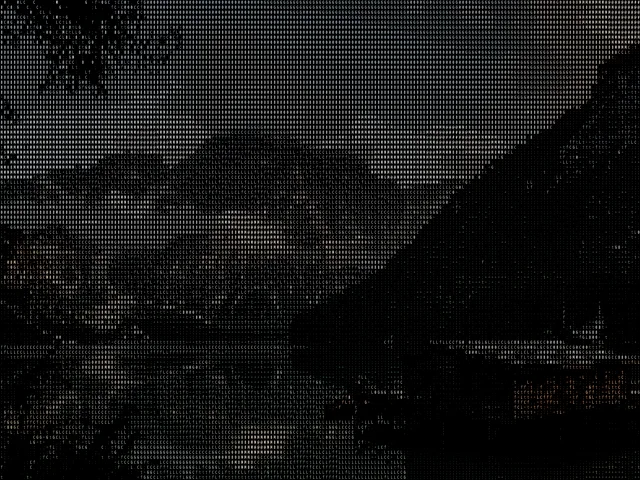
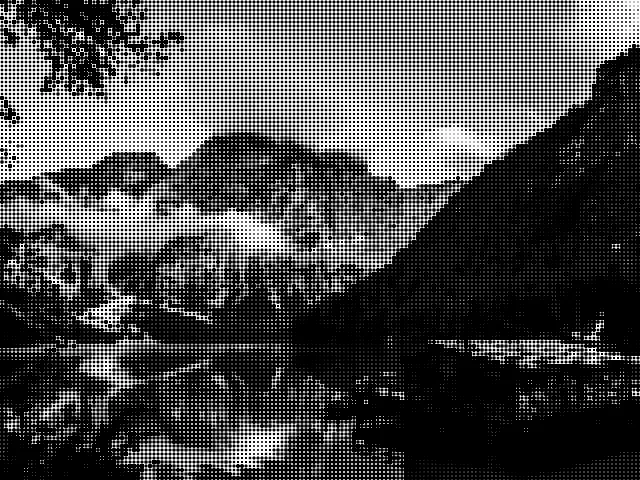
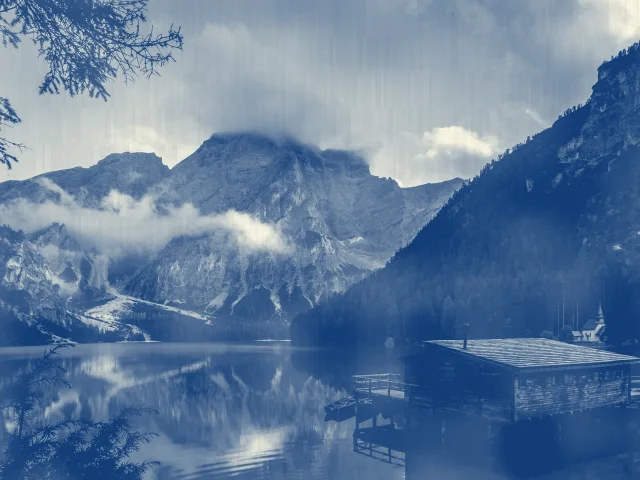
Free Dither converter
Reduce images to a black-and-white or source-color palette with ordered pixel patterns.
Drop an image or video here
Images up to 50 MiB · safe SVG up to 256 KiB · videos up to 512 MiB
Processed on your device. No account, no upload.
How to convert your file
- Choose an image or video, or drag the file into the preview. Your file stays on your device.
- Adjust the effect and compare it with the original. All effect controls are available in the parameter panel.
- Choose your output settings and download the result. Processing and encoding happen in your browser.
How the Dither effect works
Dithering represents tones with patterns from a limited palette. Choose multilevel Bayer, fixed threshold, Bayer 2 × 2, Bayer 4 × 4, Bayer 8 × 8 or interleaved noise. Multilevel Bayer also exposes the number of tonal levels. Source colors processes each source RGB channel; turn it off to use your ink and paper colors. Contrast, gamma and pattern strength refine the result.
- Image
- Adjust the treatment on a still image and download a PNG, JPEG or WebP. The output keeps the source aspect ratio and can be up to 1920 pixels on its longest edge.
- Video
- Apply the treatment to a selected clip and download MP4 or WebM, depending on your browser. Set the starting point and a duration of up to 60 seconds; the original audio can be kept.
A few ways to shape the result
- Start with Bayer 4 × 4 for a balanced, recognizable pattern.
- Choose foreground and background colors with enough separation.
- Use a larger pattern scale for a chunky print-inspired texture.
Good to know
What is the difference between threshold and Bayer dithering?
Threshold makes a direct light-or-dark choice. Binary Bayer distributes those choices with an ordered matrix to suggest intermediate tones; Multilevel Bayer retains more tonal levels. With Source colors off, the result uses your ink and paper palette. With it on, each RGB channel is processed separately.
Is my file sent to a server?
No. The file is read locally and processed with the Melt renderer in your browser. The page can download application code and the optional example image, but it does not upload your selected media.
What can I download?
Choose PNG for a lossless image, JPEG for a compact photograph, or WebP when supported. The longest output edge is capped at 1920 pixels and smaller sources are not enlarged. The ASCII treatment is exported visually, not as a text file. Choose automatic encoding, MP4 or WebM. Supported codecs depend on your browser. The selected clip can be up to 60 seconds, at 30 fps, with up to 1920 pixels on its longest edge. Audio is included when enabled and present in the source.
Can I change the look after I choose a file?
Yes. The effect stays adjustable while you preview. Change its parameters, compare the source and result, and download again. The source file is not modified. Your selection is released when you leave the tool.